
Updated March 2026
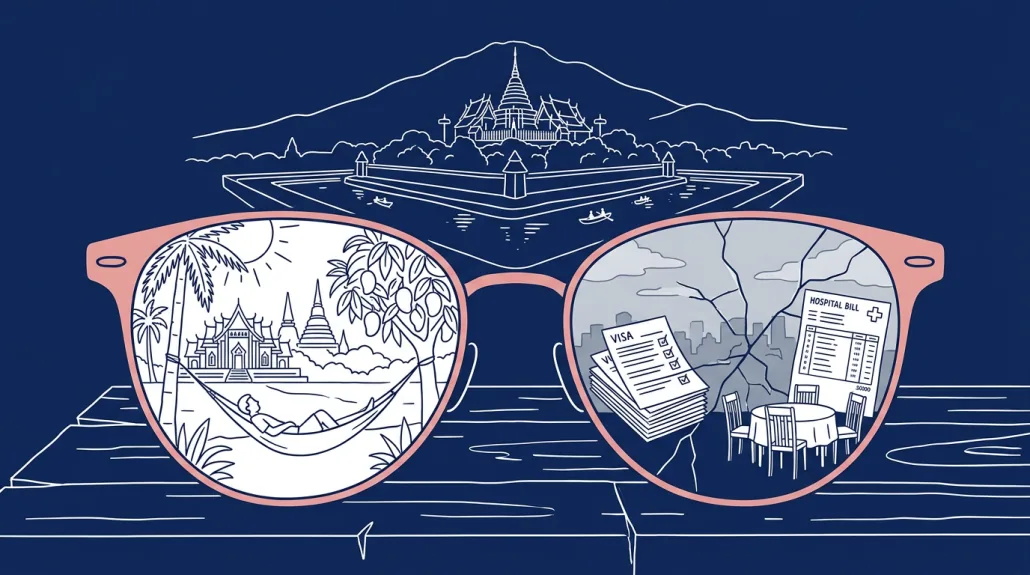
Everyone online seems to be “moving to Chiang Mai”. Cheap rent, great food, friendly locals, endless lattes – what could go wrong? On a two‑week trip, honestly, not much. On a permanent retirement visa, it is a different story.
If you are picturing selling the house, bringing the dog, and living out the rest of your life under the mango trees… hit pause. Chiang Mai can be fantastic, but it is not a magic escape button. For the wrong person, it is smoky, lonely, hot, and more bureaucratic than you bargained for.
If three or four of the points below sound uncomfortably familiar, Chiang Mai might be a place you visit often – not the place you bet your entire retirement on.
1. You can’t handle bad air and extreme heat
Let’s start with the thing almost every glossy video downplays: burning season. Roughly February to April, Chiang Mai’s air quality can go from “blue sky Instagram” to “why does the mountain disappear?” in a week. Some years the city has genuinely ranked among the worst in the world for PM2.5.
If you have asthma, heart issues, or just like breathing without checking an app first, those months are rough. Think windows closed, air purifiers humming, and timing your supermarket run for when the AQI looks slightly less awful. I know people who love Chiang Mai but leave for the entire season because their lungs simply cannot take it anymore.
Then there is the heat. Hot‑season days in the mid‑30s, concrete, and strong sun are no joke. You can adapt – early morning walks, long afternoon naps, fewer heroic midday missions – but if you already hate hot weather, this is not going to transform you into a beach‑lover.
If you are not willing or able to disappear to the coast, to another country, or back home for 2–3 months a year, be honest: a full‑time base here might not be kind to your health.
2. You hate bureaucracy but want an easy retirement visa
A lot of people hear “Thailand has a retirement visa” and mentally translate that as “I’ll get a stamp once and live happily ever after.” That is not how it works.
Retirement options exist, yes – and plenty of people in Chiang Mai use them. But there are financial requirements, paperwork, 90‑day reporting, annual extensions, and the occasional rule change that appears just when you thought you understood everything.
If a trip to your home‑country tax office already ruins your week, Thai immigration is not going to be your favourite hobby. Most long‑term retirees here fall into one of two camps:
- They learn the system, keep their bank balances and paperwork organized, and treat it as part of life.
- Or they pay a professional to handle most of the hassle.
If you are not prepared to invest either time or money into staying legal, this will not feel like “freedom in Thailand”. It will feel like a low‑level, ongoing fight with forms, photocopies, and appointments.
3. You need beaches and sea air in your daily life
This one is simple: Chiang Mai has mountains, temples, rice fields, coffee shops, and cool little sois. It does not have a beach. At all.
If your personal vision of “retiring in Thailand” involves walking barefoot on sand every morning and rinsing off in the sea, you are looking at the wrong city. Your daily walk here is more likely around the moat, the Old City, or a park than along a shoreline.
Can you split your time – winters in Chiang Mai, summers by the sea? Absolutely. A lot of people do exactly that. Just be realistic: that means extra flights, extra rent, and extra logistics. It is a great plan if your budget can handle it. But if you are moving here specifically because “it’s cheap”, then needing two bases may completely change your math.
4. You assume healthcare will be cheap and simple forever
In the first couple of years, Thai healthcare can feel like a cheat code. Private hospitals, short waiting times, dentist appointments next week instead of “in four months” – and the bill is often lower than your deductible back home.
The story changes as you age. Insurance premiums climb. Some companies do not want to cover new customers over a certain age, or they exclude anything you have ever had trouble with. For serious or very specialized treatment, you may end up in Bangkok or back in your home country anyway.
If your plan is “I’ll move to Thailand because healthcare is cheap, and that means I don’t need much savings or insurance,” you are playing with fire. Thailand can absolutely be part of a smart healthcare strategy. It is not a replacement for an emergency fund, decent insurance, and a clear idea of what you’d do if something big and long‑term goes wrong.
5. Your budget only works if everything stays “dirt cheap”
Yes, you can live more cheaply in Chiang Mai than in London, Sydney, Vancouver, or Los Angeles. A basic but livable apartment, local food, and a simple lifestyle can be surprisingly affordable.
But there are a few traps:
- Imported food, wine, craft beer, and Western‑style groceries add up.
- Flights home, border hops, and “I’ll just spend burning season at the beach” are not free.
- If you want a elevator building, pool, and gym in a central area, you are not paying backpacker rates.
Then add wildcards you do not control: exchange rates, inflation, visa rules, and health costs. If your budget only works because you assume the baht will always be weak and your expenses will never surprise you, that is not a retirement plan – that is hope.
A blunt test: if you could barely afford to retire in your home country, moving somewhere “cheap” does not magically fix the underlying numbers. It just hides the problem until something forces you to spend.
6. You need to feel fully integrated, not “the foreigner”
Thailand is friendly. Chiang Mai is used to foreigners. But you are still a farang. That does not change after one year, five years, or ten.
Legally, you are always on some kind of permission to stay. You cannot vote. Long‑term residence and citizenship exist, but they are not quick or guaranteed. Culturally, you will often sit a bit outside the circle. Many foreigners here never get beyond basic Thai; some do great with the language but still get treated as “the foreign guy” in local settings.
Some people genuinely do not mind. They are happy to be polite guests, respect the rules, and build their own mixed Thai‑foreigner social life. Others find it slowly grinds them down that they are never fully “of” the place, only “in” it.
If you know you need to feel fully integrated, involved in politics, and treated exactly like a local citizen to be at peace, Thailand in general – and Chiang Mai included – may never fully scratch that itch.
7. You struggle with “saving face” and indirect communication
Thai culture generally avoids open confrontation. People tend to say “maybe” or “we’ll see” where a Westerner might expect a clear yes or no. Things are often left unsaid. People smile through situations that would cause an argument elsewhere.
If you are naturally patient and easy‑going, this can be one of the nicest parts of living here. If you are very direct, blunt, and prone to losing your temper, it is going to test you. Hard.
Raising your voice at immigration, the bank, or a hospital might feel normal where you come from. Here it can quietly make your life worse. The person you shouted at will still smile, but your problem may suddenly become much more “complicated”.
Retiring in Chiang Mai works far better for people who can take a deep breath, accept a slower process, and choose carefully when to push and when to let things slide. If you are already furious just thinking about that, it is worth listening to that feeling.
8. You underestimate loneliness and expat churn
Scroll through social media and it looks like Chiang Mai is one big, permanent expat happy hour. Meetups. Co‑working spaces. Hiking groups. Salsa nights. There is always something going on.
Underneath that, the reality is a bit messier. People come and go. Digital nomads stay a season and disappear. Long‑term expats move cities, change visas, go home for family reasons. That friend group you built in your first year may look completely different by year three.
If you are great at making friends from scratch, you will probably be fine. If you have spent the last 20 years with the same handful of friends and do not love starting from zero, you need to be honest about how much social energy you have left.
It is absolutely possible to build a real community here – but it is not automatic, and it does not happen from your sofa.
9. You are not comfortable with traffic, motorbikes, or limited public transport
On a map, Chiang Mai looks walkable and compact. In real life, big roads, hot sun, and uneven sidewalks mean most people do not walk very far for day‑to‑day life.
There is no skytrain or metro. Buses exist but are limited. A lot of foreigners end up on motorbikes or scooters. That can be fun when you are 30. At 70, less so – especially in city traffic. Road accidents are common, and a “small fall” can be a very big deal if your bones and recovery time are not what they used to be.
Can you live here without driving? Yes. Plenty of retirees do it by:
- Choosing a condo near the places they use most.
- Relying on red trucks, Grab, Bolt, and taxis.
- Accepting that they will not be zipping off to waterfalls every weekend.
If you already hate driving, hate traffic, and hate relying on others for lifts, it is worth thinking hard about how much this matters to your daily happiness.
10. You need long‑term certainty in a world that offers none
This last one is not really about Chiang Mai, but it hits hard here because so many people arrive convinced they have “solved” retirement.
Visa rules change. Tax rules change. Health changes. Family situations change. Your home country might suddenly look more or less attractive than it does today. Thailand might tighten or relax rules for retirees. None of this is under your direct control.
If you absolutely must know that you can stay in one foreign city for the next 25 years with zero interruptions, that is not a realistic expectation anywhere.
The people who seem happiest in Chiang Mai treat it as a brilliant option – not a guaranteed right. They keep backup plans. They stay flexible. They know how they would handle it if a rule, a policy, or their own body suddenly changed the game.
So…should you still consider Chiang Mai?
All of this might sound negative, but it is not meant to scare you off. Chiang Mai really is a fantastic place for the right kind of retiree: someone reasonably healthy, flexible, not terrified of paperwork, and realistic about money. If that sounds like you, you might love it here.
The point is simply this: do not move here on fantasy mode. Test your assumptions. Visit for a long stay. Experience burning season with your own lungs. Try a hospital. Sit in traffic. Attempt a visa extension. Talk to people who have been here ten years, not ten days.
If several of the reasons above had you nodding along, Chiang Mai might be better as a place you spend a few months a year. If you read them and thought “I can handle that,” then maybe it is worth taking the next step.
Either way, if you are thinking seriously about basing your retirement around Chiang Mai, it is worth having someone look over your plan with you – your visa options, your timeline, your risks. That is the kind of conversation we have every week.